The 7-Step Software Development Process That Keeps Projects On Time

Ask why a software project failed and you will rarely hear "the code was bad". You will hear that requirements kept changing, that nobody could see progress until it was too late, or that the launch surfaced problems everyone assumed someone else was handling.
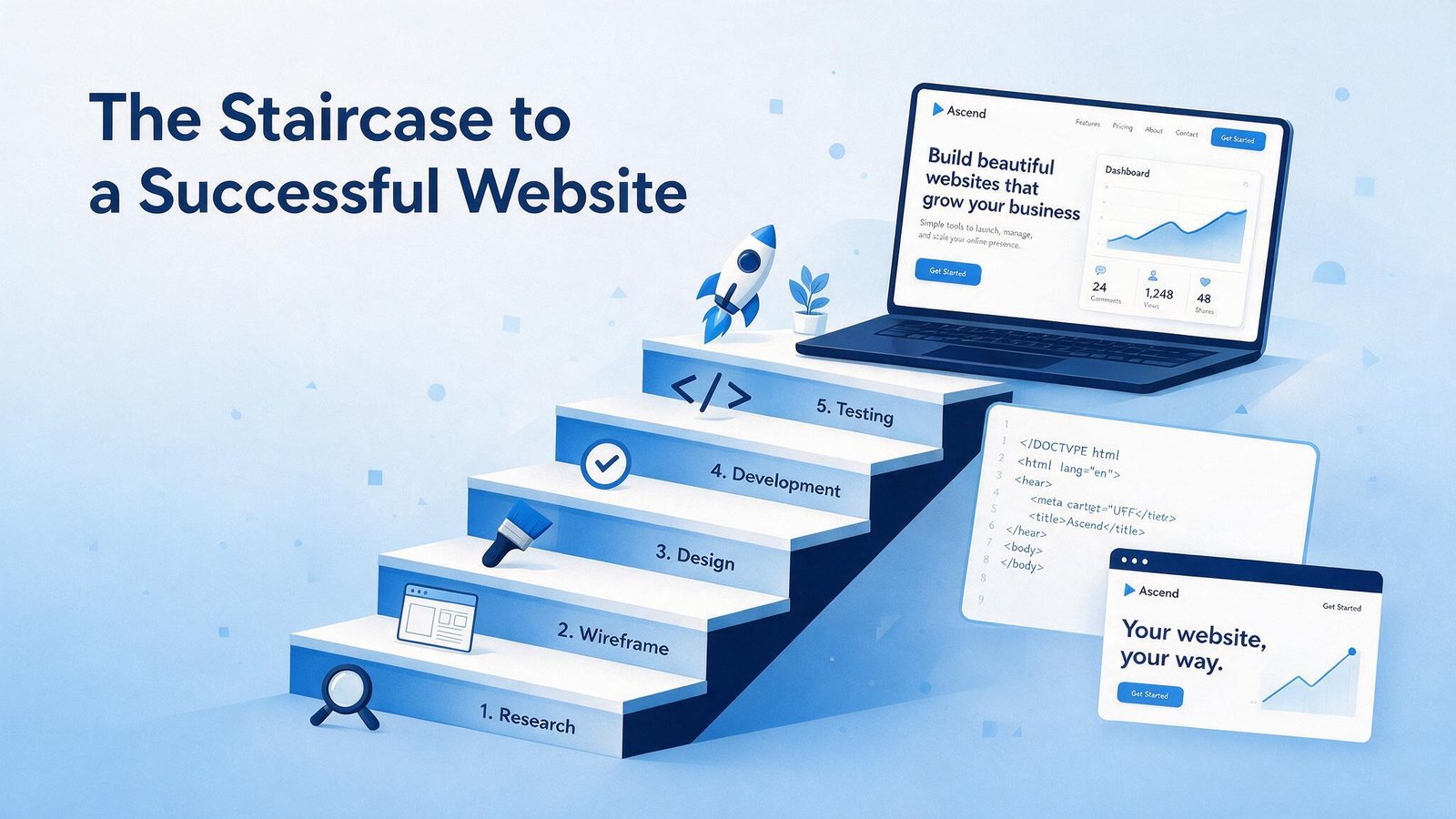
A visible, milestone-driven process solves most of that. Here is the seven-step process we run, and — more usefully — why each step earns its place.
1. Idea & Requirement Analysis
We start by understanding your goals, your users and the constraints you cannot move. The output is a written scope: what is being built, what is explicitly not being built in this phase, and what "done" means. Skipping this is the single most common cause of a project that never ends.
2. Planning & Strategy
Now the scope becomes a plan: milestones, a realistic timeline, the technology stack, and the hosting and integration decisions. Technology is chosen against your constraints — your team, your budget, your existing systems — not against fashion.
3. Design & Prototyping
Wireframes first, then visual design, then a clickable prototype. This is where confusion is cheapest to fix. Changing a flow in a prototype costs an afternoon; changing it after development costs a rebuild. You approve what the product will look and feel like before a line of production code exists.
4. Development & Implementation
Building happens in short, reviewable increments, with version control, code review and a working demo at each milestone. You should never have to ask "how is it going?" — you should be able to see it. Invisible progress is how three-month projects become nine-month projects.
5. Testing & Quality Assurance
Functional testing, regression testing, performance checks, security review against the OWASP Top 10, and verification on real devices and browsers. Bugs found here are cheap. Bugs found by your customers are not — they cost credibility as well as time.
6. Deployment & Launch
Servers hardened, SSL configured, backups automated and restore-tested, monitoring live, and a rollback path ready before the first user arrives. A launch should be uneventful. If it is exciting, something was skipped.
7. Maintenance & Support
Launch day is the beginning. Dependencies age, certificates expire, operating systems change, and your business evolves. Ongoing patching, monitoring, backups and small improvements are what separate software that lasts five years from software that quietly rots in six months.
Why the order matters
Each step exists to make the next one cheaper. Requirements make design possible. Design makes development predictable. Testing makes deployment safe. Deployment makes maintenance manageable. Remove a step and the cost does not disappear — it just reappears later, larger, and at a worse moment.
This is exactly the process we run on every engagement. You can see it laid out on our services page, along with what each phase produces.
Need help with a project like this?
Tell us your requirement — we reply with a scope, timeline and quote within 24 hours.
Get a Free Quote →