Website Development for Large Enterprises: Building Secure, Scalable, and High-Performance Digital Platforms
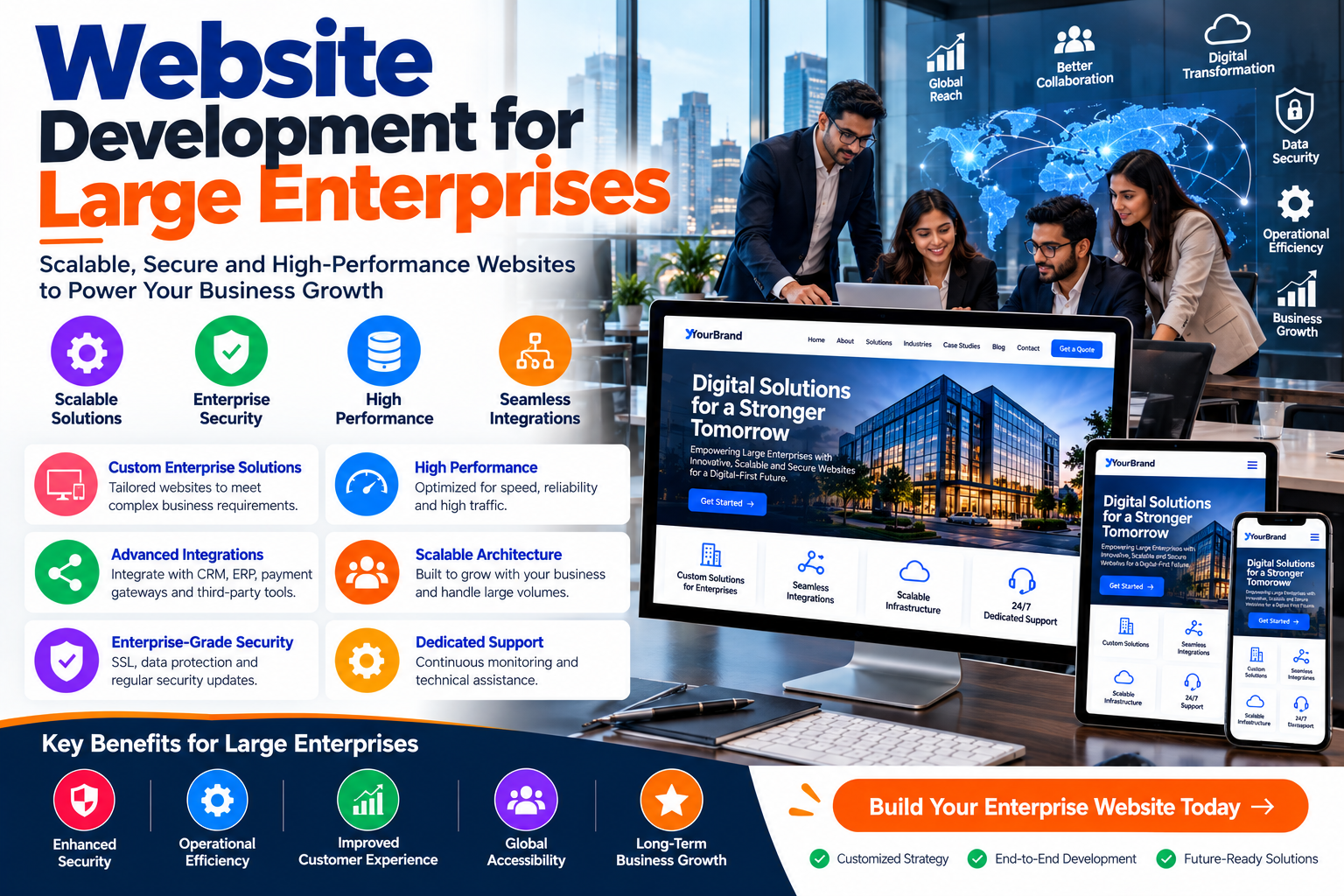
In today’s digital economy, a website is no longer simply an online presence for a large organization. For many enterprises, it functions as a critical business platform connecting customers, employees, partners, suppliers, applications, databases, and digital services.
This makes website development for large enterprises significantly different from building a standard small business website.
Large enterprises typically manage greater volumes of content, users, traffic, transactions, integrations, and sensitive business information. Their websites may need to operate across multiple locations, departments, languages, brands, and markets while maintaining consistent performance and security.
An enterprise website must therefore be designed with scalability, security, performance, reliability, accessibility, integration, SEO, and long-term maintainability in mind.
A successful enterprise website may serve thousands or even millions of visitors while supporting complex functionality such as customer portals, e-commerce systems, content management, employee platforms, CRM integrations, payment processing, analytics, APIs, and business automation.
This guide explores the essential elements of enterprise website development, including features, technologies, security considerations, scalability, development processes, integrations, SEO, performance, and long-term maintenance.
What Is Enterprise Website Development?
Enterprise website development is the process of designing, developing, deploying, and maintaining large-scale websites and web platforms for organizations with complex operational requirements.
Unlike a simple informational website, an enterprise platform may need to interact with multiple internal and external systems.
These can include:
- Customer Relationship Management (CRM)
- Enterprise Resource Planning (ERP)
- Payment systems
- Customer databases
- Inventory systems
- Marketing automation tools
- Business intelligence platforms
- Authentication systems
- Third-party APIs
- Customer support platforms
Enterprise development focuses not only on appearance but also on creating a reliable technical architecture capable of supporting business operations over the long term.
Why Large Enterprises Need Professional Website Development
Large organizations usually have multiple audiences.
A single enterprise website may serve:
- Customers
- Business partners
- Investors
- Employees
- Suppliers
- Distributors
- Job applicants
- Media organizations
- International visitors
Each audience may require different information and functionality.
A professionally developed enterprise website helps organize these requirements into a consistent digital experience.
It can support customer acquisition, sales, recruitment, customer service, investor communication, marketing, brand management, and internal operations.
For this reason, enterprise website development should be treated as part of an organization's broader digital infrastructure rather than simply as a design project.
Key Benefits of Enterprise Website Development
| Benefit | Business Impact |
|---|---|
| Scalability | Supports increasing users, content, and traffic |
| Strong Security | Helps protect systems and sensitive information |
| High Performance | Provides faster and more reliable experiences |
| System Integration | Connects CRM, ERP, APIs, and business tools |
| Brand Consistency | Maintains a unified identity across departments |
| SEO | Supports large-scale organic visibility |
| Analytics | Enables data-driven business decisions |
| Automation | Reduces repetitive manual processes |
| Global Reach | Supports multiple markets and languages |
| Reliability | Helps maintain business continuity |
| Personalization | Delivers more relevant user experiences |
| Content Management | Simplifies large-scale content operations |
1. Scalable Website Architecture
Scalability is one of the most important considerations in enterprise website development.
A website may initially receive moderate traffic but experience significant growth during marketing campaigns, product launches, seasonal demand, or business expansion.
Enterprise architecture should be designed to handle changing requirements without requiring the entire platform to be rebuilt.
Scalability may involve:
- Load balancing
- Cloud infrastructure
- Database optimization
- Caching
- Content Delivery Networks
- Horizontal scaling
- Modular architecture
- API-based services
- Performance monitoring
The appropriate architecture depends on the organization's expected traffic, functionality, availability requirements, and technology environment.
Planning for scalability early can reduce technical limitations as the organization grows.
2. Enterprise-Level Security
Security is essential for every website, but it becomes particularly important for large organizations.
Enterprise websites may process customer accounts, employee information, business documents, transactions, personal information, and other sensitive data.
Security considerations may include:
- HTTPS encryption
- Secure authentication
- Multi-factor authentication
- Role-based access control
- Regular security updates
- Vulnerability assessments
- Secure API communication
- Web application firewalls
- Security monitoring
- Backup systems
- Incident response planning
Security requirements should be determined according to the type of information processed and applicable regulations.
Enterprise security should also follow the principle of least privilege, meaning users should receive only the access required to perform their responsibilities.
3. High Website Performance
Large enterprise websites often contain significant amounts of content, images, scripts, integrations, and functionality.
Without proper optimization, these elements can negatively affect performance.
Performance optimization may include:
- Image optimization
- Code minification
- Browser caching
- Server-side caching
- Database optimization
- CDN implementation
- Lazy loading
- Script optimization
- Efficient API requests
- Infrastructure monitoring
Website performance should be measured continuously rather than only during development.
Traffic patterns and functionality can change over time, making ongoing monitoring important.
4. Responsive and Mobile-Friendly Design
Enterprise websites must provide a consistent experience across devices.
Users may access enterprise platforms through:
- Smartphones
- Tablets
- Laptops
- Desktop computers
- Different browsers
- Different screen resolutions
Responsive website design allows layouts and content to adapt according to available screen size.
Important responsive elements include:
- Flexible layouts
- Responsive images
- Touch-friendly buttons
- Mobile navigation
- Readable typography
- Responsive forms
- Optimized tables
- Appropriate content hierarchy
Mobile responsiveness should be considered throughout the design process rather than added after desktop development is completed.
5. Enterprise Content Management System
Large organizations may have hundreds or thousands of website pages managed by different departments.
An enterprise-grade Content Management System (CMS) can help authorized users manage this content efficiently.
A CMS may allow teams to control:
- Pages
- Blog articles
- News
- Products
- Services
- Case studies
- Careers
- Media
- Documents
- Landing pages
- FAQs
Enterprise content management may also require approval workflows.
For example, one employee may create content, another may review it, and an authorized manager may approve it before publication.
This can help maintain content quality and brand consistency.
6. Role-Based Access Control
Large organizations typically have multiple website administrators and content managers.
Giving every user complete administrative access creates unnecessary risk.
Role-based access control can provide different permissions for:
- Super administrators
- Developers
- Content editors
- Marketing teams
- HR teams
- Customer support
- Regional managers
- Product managers
Each user should have access only to the features and information necessary for their responsibilities.
This improves security and makes enterprise content management more organized.
7. CRM Integration
Customer Relationship Management systems are important for many large enterprises.
Integrating a website with a CRM can help automatically transfer website leads and customer information into appropriate business workflows.
For example, when a visitor submits an enterprise contact form, the information can potentially be sent to a CRM for follow-up.
CRM integration may support:
- Lead management
- Customer tracking
- Sales workflows
- Marketing automation
- Customer segmentation
- Reporting
The exact integration depends on the CRM and organizational requirements.
8. ERP Integration
Enterprise Resource Planning systems help organizations manage internal business operations.
Depending on the business, website integration with ERP systems may help synchronize:
- Inventory
- Orders
- Products
- Pricing
- Customer information
- Supply chain information
- Financial data
Such integrations can reduce repetitive manual data entry.
However, ERP integration can be technically complex and should be carefully designed, secured, tested, and monitored.
9. API Integration
Modern enterprise websites rarely operate in isolation.
APIs allow different applications and platforms to exchange information.
Enterprise websites may integrate with APIs for:
- Payments
- Shipping
- Maps
- Authentication
- CRM
- ERP
- Customer support
- Analytics
- Marketing
- Inventory
- Communication
API integrations should include appropriate authentication, error handling, monitoring, and security.
Developers should also plan for situations where an external service becomes temporarily unavailable.
10. Enterprise SEO
Large websites create unique SEO challenges.
An enterprise website may contain thousands of URLs, multiple product categories, regional pages, languages, and dynamically generated content.
Enterprise SEO may involve:
- SEO-friendly URLs
- Page titles
- Meta descriptions
- Heading structures
- Canonical tags
- XML sitemaps
- Internal linking
- Redirect management
- Structured data
- Image optimization
- Crawl management
- Duplicate content management
- Page performance
- Mobile optimization
SEO processes should also be integrated with content publishing workflows.
This can help reduce issues such as missing metadata, duplicate pages, broken internal links, and incorrect redirects.
11. Advanced Website Search
Large enterprise websites may contain huge amounts of information.
Visitors should not need to browse dozens of pages to locate a specific resource.
An effective website search system can help users find:
- Products
- Services
- Documents
- Articles
- FAQs
- Support resources
- Locations
Depending on requirements, advanced search may include filters, categories, suggestions, and relevance-based results.
Search analytics can also reveal what visitors are trying to find, helping organizations identify content gaps.
12. Multilingual Website Support
Large enterprises often operate across different countries and regions.
Multilingual functionality can help organizations deliver content to audiences in different languages.
Enterprise multilingual development may require:
- Language selection
- Translation workflows
- Localized content
- Localized URLs
- Regional information
- SEO localization
- Language-specific metadata
Simply translating words may not always be sufficient.
Content may need to be adapted to regional terminology, currency, legal requirements, customer expectations, and cultural context.
13. Multi-Location and Multi-Region Management
Organizations operating across multiple cities or countries may require dedicated location pages.
These pages can contain:
- Local addresses
- Contact numbers
- Office hours
- Services
- Regional teams
- Maps
- Localized content
A centralized management system can help maintain consistent branding while allowing appropriate regional customization.
14. Personalization
Enterprise websites may serve several types of visitors with different interests.
Personalization can help present more relevant information based on appropriate user context.
Depending on the implementation and applicable privacy requirements, personalization might consider:
- Selected preferences
- Account status
- Previous interactions
- Geographic region
- Customer segment
- Product interests
Personalization should be implemented carefully and transparently, particularly when user information is involved.
15. Enterprise E-Commerce
Large enterprises selling products online may require advanced e-commerce capabilities.
These can include:
- Large product catalogs
- Product variations
- Advanced search
- Customer accounts
- Shopping carts
- Secure checkout
- Payment integrations
- Inventory synchronization
- Order management
- Shipping integrations
- Discounts
- Tax management
- Returns workflows
B2B enterprises may also require custom pricing, bulk ordering, customer-specific catalogs, approval processes, and account-based purchasing.
Enterprise Website Features Checklist
| Feature | Enterprise Priority |
|---|---|
| Responsive Design | Essential |
| Enterprise Security | Essential |
| Scalable Architecture | Essential |
| High Performance | Essential |
| Enterprise CMS | Essential |
| SEO Architecture | Essential |
| Role-Based Access | Essential |
| Analytics | Essential |
| CRM Integration | High |
| ERP Integration | Based on Requirements |
| API Integration | High |
| Multilingual Support | For Global Enterprises |
| Advanced Search | High |
| Personalization | Based on Strategy |
| Disaster Recovery | Essential |
16. Accessibility
Accessibility should be considered throughout enterprise website design and development.
Important considerations can include:
- Keyboard navigation
- Descriptive image alt text
- Proper heading hierarchy
- Clear form labels
- Sufficient contrast
- Accessible navigation
- Descriptive links
- Captions or transcripts where appropriate
Accessibility improves usability for a wider audience and may also be important for organizational compliance requirements.
17. Enterprise Analytics and Reporting
Enterprise websites generate valuable information about customer behavior and digital performance.
Analytics can help organizations monitor:
- Website traffic
- User journeys
- Traffic sources
- Conversion rates
- Lead generation
- Product interactions
- Search behavior
- Device usage
- Landing page performance
- Campaign performance
Large organizations may also connect website analytics with CRM, business intelligence, and marketing platforms.
This provides a broader understanding of how digital activities contribute to business outcomes.
18. Conversion Optimization
High traffic does not automatically create business results.
Enterprise websites should be designed around meaningful conversions.
Depending on the organization, conversions may include:
- Product purchases
- Demo requests
- Quote requests
- Contact submissions
- Account registrations
- Downloads
- Newsletter subscriptions
- Job applications
Conversion optimization can involve improving page layouts, CTAs, forms, content, navigation, and user journeys.
Testing should be based on measurable outcomes rather than assumptions.
19. Cloud Infrastructure
Cloud infrastructure can provide flexibility for enterprise platforms.
Depending on architecture and business requirements, cloud services can support:
- Scalable computing
- Data storage
- Backups
- Load balancing
- Monitoring
- Disaster recovery
- Content delivery
However, simply moving a website to the cloud does not automatically guarantee scalability or security.
The architecture still needs to be properly designed and managed.
20. Backup and Disaster Recovery
Enterprise websites should have a documented backup and recovery strategy.
A technical failure, human error, cyber incident, or infrastructure problem can potentially disrupt business operations.
A recovery strategy may include:
- Automated backups
- Database backups
- Off-site copies
- Version control
- Recovery procedures
- Recovery testing
- Redundant infrastructure
Backups should be tested periodically because a backup is only valuable if it can actually be restored.
Enterprise Website Development Process
| Stage | Main Activities |
|---|---|
| Discovery | Understand business goals and stakeholders |
| Requirements | Define functionality, integrations, and security |
| Architecture | Design scalable technical infrastructure |
| UI/UX | Create user journeys and interface systems |
| Development | Build frontend, backend, APIs, and CMS |
| Integration | Connect CRM, ERP, payments, and other tools |
| Testing | Perform functional, security, and device testing |
| Performance | Optimize infrastructure and application performance |
| SEO | Configure technical SEO requirements |
| Deployment | Launch through controlled processes |
| Monitoring | Track errors, availability, and performance |
| Maintenance | Apply updates and continuous improvements |
21. Quality Assurance and Testing
Enterprise websites require comprehensive testing because problems can affect large numbers of users.
Testing can include:
- Functional testing
- Browser testing
- Device testing
- Responsive testing
- Integration testing
- Performance testing
- Security testing
- Accessibility testing
- User acceptance testing
Critical functionality such as login systems, forms, payments, APIs, and customer portals should be tested carefully before deployment.
22. DevOps and Continuous Deployment
Large websites often require frequent updates.
Modern development workflows can use automated processes for building, testing, and deploying code.
DevOps practices may include:
- Version control
- Automated testing
- Continuous integration
- Deployment pipelines
- Monitoring
- Logging
- Rollback procedures
These practices can help development teams release updates more consistently while reducing deployment risks.
23. Enterprise Website Maintenance
Enterprise development continues after launch.
Large websites require ongoing technical and content management.
Maintenance may include:
- Security patches
- Software updates
- Content updates
- Performance optimization
- Backup monitoring
- Integration monitoring
- Error tracking
- SEO audits
- Accessibility reviews
- Infrastructure monitoring
Organizations should establish clear responsibility for each area rather than relying only on occasional maintenance.
24. Common Enterprise Website Development Mistakes
Even large organizations can make costly website development mistakes.
Common problems include:
- Building without clear requirements
- Using an architecture that cannot scale
- Ignoring mobile users
- Poor website performance
- Weak access controls
- Insufficient security testing
- Complicated navigation
- Poor content governance
- No disaster recovery plan
- Lack of analytics
- Poor API documentation
- Ignoring accessibility
- Excessive third-party scripts
- Inconsistent branding
- No long-term maintenance strategy
Many of these problems can be reduced through better planning before development begins.
Small Business Website vs Enterprise Website
| Factor | Small Business Website | Enterprise Website |
|---|---|---|
| Website Size | Usually smaller | Often very large |
| User Volume | Low to moderate | Potentially very high |
| Architecture | Relatively simple | Complex and scalable |
| Integrations | Limited | Multiple enterprise systems |
| Security | Important | Advanced requirements |
| CMS | Basic to moderate | Enterprise-level workflows |
| User Roles | Few | Multiple roles and departments |
| Languages | Usually limited | Often multilingual |
| Infrastructure | Standard hosting may suffice | Cloud/distributed infrastructure may be needed |
| Maintenance | Smaller team | Dedicated teams may be required |
| Analytics | Standard reporting | Advanced analytics and BI integrations |
| Development Complexity | Lower | Significantly higher |
25. How Much Does Enterprise Website Development Cost?
There is no universal fixed price for enterprise website development.
Cost depends heavily on the size and complexity of the project.
Major factors include:
- Number of pages
- Custom UI/UX
- CMS requirements
- User roles
- Custom backend systems
- CRM integration
- ERP integration
- API integrations
- E-commerce functionality
- Security requirements
- Multilingual support
- Cloud infrastructure
- Data migration
- Testing requirements
- SEO implementation
- Maintenance and support
A large enterprise website should therefore be estimated after detailed requirements and technical discovery rather than priced only by the number of pages.
26. Choosing an Enterprise Website Development Company
Selecting the right development partner is critical for large organizations.
An enterprise development company should be evaluated based on:
- Enterprise development experience
- Technical expertise
- Security practices
- Scalability knowledge
- UI/UX capabilities
- API integration experience
- Cloud expertise
- Testing processes
- SEO knowledge
- Project management
- Maintenance capabilities
- Communication and documentation
Organizations should also establish clear requirements around source code ownership, documentation, deployment, data protection, support, and ongoing maintenance before development begins.
Frequently Asked Questions
What is enterprise website development?
Enterprise website development is the process of creating large-scale web platforms for organizations with complex requirements such as high traffic, multiple users, integrations, security controls, advanced content management, and scalable infrastructure.
How is an enterprise website different from a normal website?
Enterprise websites generally support more users, content, integrations, departments, permissions, and business processes than standard websites. They may also require advanced security, infrastructure, monitoring, and content governance.
What features should an enterprise website have?
Important features can include responsive design, scalable architecture, enterprise security, CMS functionality, role-based access, analytics, SEO, advanced search, integrations, monitoring, backups, and disaster recovery.
Are enterprise websites SEO-friendly?
They can be, provided SEO is incorporated into the architecture and content workflows. Large websites require careful management of URLs, metadata, canonicalization, internal links, redirects, sitemaps, and duplicate content.
Do enterprise websites need cloud infrastructure?
Not every enterprise website requires the same infrastructure. Cloud platforms can provide useful scalability and reliability capabilities, but the appropriate infrastructure depends on business and technical requirements.
Can an enterprise website integrate with CRM and ERP systems?
Yes. Enterprise websites can integrate with compatible CRM, ERP, payment, inventory, marketing, support, and other systems through APIs or supported integration methods.
How long does enterprise website development take?
Development time varies considerably depending on requirements, integrations, security, content migration, testing, stakeholder approvals, and project complexity.
Is enterprise website security important?
Yes. Enterprise websites may handle significant volumes of customer and organizational information, making authentication, authorization, encryption, monitoring, updates, testing, backups, and incident planning important.
Conclusion
Website development for large enterprises requires a strategic approach that goes far beyond creating an attractive website.
Enterprise platforms must support complex business requirements while providing reliable experiences for customers, employees, partners, investors, and other stakeholders.
A successful enterprise website should combine scalable architecture, strong security, high performance, responsive design, enterprise content management, SEO, accessibility, analytics, integrations, and long-term maintainability.
Organizations should also prepare for future growth.
As traffic, content, business locations, services, products, integrations, and customer expectations increase, the website should be capable of evolving without requiring constant redevelopment.
Enterprise website development is therefore not simply a one-time technology project. It is an ongoing digital investment that can support customer acquisition, business operations, marketing, communication, automation, and long-term organizational growth.
With the right strategy, technology architecture, development process, and maintenance plan, an enterprise website can become a powerful digital foundation for the entire organization.
Need help with a project like this?
Tell us your requirement — we reply with a scope, timeline and quote within 24 hours.
Get a Free Quote →